Data Analytics
The AI reporting analytics team that replaces your backlog, not your people
Every data team runs into the same wall. Not a technology wall – a people wall.
On one side, business stakeholders fire off Slack messages: “Can I get the latest numbers in a Sheet?” On the other, analysts queue the request behind twelve others, run the query, export a CSV, paste it into Google Sheets, fix the formatting, and share the link. Tomorrow, someone asks for a refresh. The cycle restarts.
The backlog never shrinks. The analyst never gets to the strategic work they were hired for. And the business user never gets an answer fast enough to act on it.
Some companies try the opposite: hand business users ChatGPT or Gemini and point them at raw warehouse data. The result? Hallucinated metrics, numbers that don’t match the dashboard, and a CFO who stops trusting any report that wasn’t built by a human. Stanford HAI’s 2025 research found that even specialized AI tools hallucinate 17% or more of the time – general-purpose chatbots hit 58–82%. The Stack Overflow 2025 Developer Survey confirms it: 46% of developers actively distrust AI tool accuracy.
This is the trap most analytics teams live in. Queue everything behind human analysts and drown in tickets. Or let business users “self-serve” with uncontrolled AI and watch trust collapse. Both paths break. And most “self-service analytics” initiatives force you to pick one.
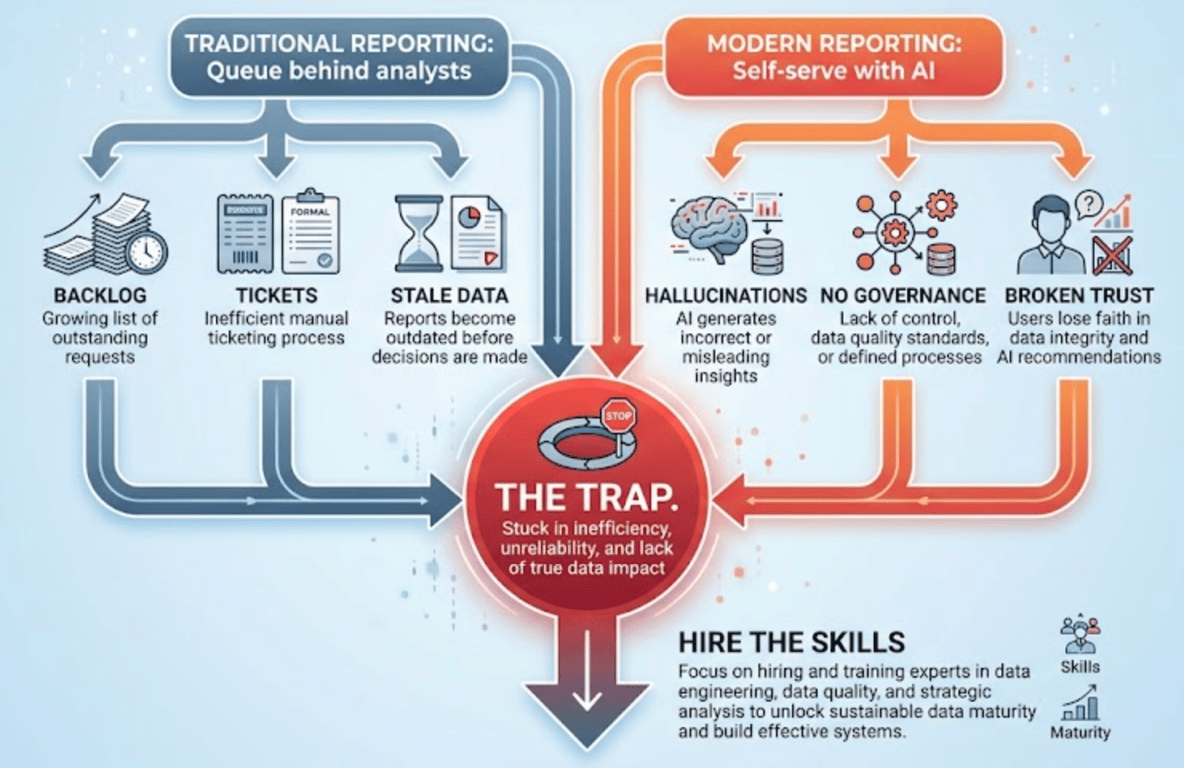
There’s a third option.
Why self-service analytics keeps failing
Why self-service analytics keeps failing
Companies have tried to solve the reporting bottleneck for a decade. Semantic layers, BI platforms, embedded analytics, natural language query tools – the graveyard of “this will finally fix it” is crowded. Here’s why nothing has stuck.
The semantic layer bet
The pitch sounds right: define metrics once in a universal layer, let everyone query from it. In practice, production-ready semantic layers take 6–12 months for enterprise teams to ship (Datacoves, 2026). The dbt State of Analytics Engineering 2025 report shows only 27% of teams plan to increase semantic-layer investment. And even after all that modeling work, business users still can’t access the layer without BI training or SQL knowledge.
BI tools business users won’t open
You build the dashboard. You add the filters. You share the link. And the first thing the marketing director does is ask you to export the data into a Google Sheet. The adoption problem isn’t the dashboard’s fault – it’s that business users live in spreadsheets, not in Looker or Tableau. Forcing them into a BI tool doesn’t solve self-service – it creates a different kind of ticket.
AI bolted onto raw data
This is the newest failure mode, and the most dangerous. ChatGPT, Gemini, and Claude are extraordinary reasoning tools – but when you point them at raw warehouse tables, they guess. They infer column meanings, fabricate joins, and produce numbers that look plausible but are wrong. With the EU AI Act now mandating traceable logic for AI insights used in significant decisions – with fines up to €35 million – “it looked right” is no longer an acceptable standard.
The reframe – hire the skills, not the tool or the headcount
The reframe – hire the skills, not the tool or the headcount
What if the problem isn’t the tools? What if it’s the model?
Every company that hires a reporting analyst is really buying a bundle of skills: writing SQL, integrating data sources, building reports, scheduling deliveries, enabling stakeholder self-service, managing access and permissions. Those skills are valuable. But most of the work that exercises them is repetitive.
OWOX flips the model. Instead of buying another platform and hoping people adopt it, you hire the skills your team needs – as governed software, controlled by the analysts who define the logic once. An AI analytics team where each “hire” automates a specific set of capabilities that a human analyst currently does by hand.
The skills have always existed. They’ve just been locked inside human analysts doing repetitive delivery work.
This isn’t a new dashboard tool. It’s not a semantic layer project. It’s not an AI chatbot bolted onto your data warehouse. It’s a team you hire – one that your existing analysts control.
Meet the team
Meet the team
Here’s who you can hire – and what each role takes off your plate.
| Role | Price | Tagline | Skill it automates | Hired by |
|---|---|---|---|---|
| Data Intern | Free | “You weren’t hired to export CSVs.” | Pulling, blending & delivering data that traces back to SQL | Data professionals |
| Reporting Analyst | from $65/mo | “Stop being the reporting bottleneck.” | Answering “quick questions,” defining metrics, spotting anomalies | Analytics leaders |
| Senior Analyst | from $90/mo | “Stop running your business blind.” | Trusted answers via @owox in Slack/Claude/ChatGPT – no hallucinations | Founders & ops leaders |
| Enterprise | Custom | “A Senior Analyst for every stakeholder.” | Company-wide governed self-service | CDOs & VPs of Data |
The Data Intern is free. It handles the work nobody should be doing manually – pulling data from sources, blending it with open-source connectors, and delivering clean, SQL-traceable datasets into Google Sheets. Every number traces back to a query. No CSV exports, no copy-paste.
The Reporting Analyst takes over the “quick questions” – the ones that eat analyst calendars alive. It defines metrics, spots anomalies, and delivers automated reports on schedule. Analysts set the logic once; the Reporting Analyst executes it forever.
The Senior Analyst is where trust becomes the product. Business users ask questions in natural language via @owox in Slack, Claude, or ChatGPT – and get answers backed by deterministic SQL. The AI narrates the insight; every number comes from analyst-approved data marts. No hallucinations. No guessing.
Enterprise scales this to every stakeholder in the organization – governed, access-controlled, with a joinable data mart layer that replaces the semantic layer project your team has been avoiding.
Compare the four analysts you can hire →

The part that matters – analysts become more valuable, not redundant
The part that matters – analysts become more valuable, not redundant
Let’s address the elephant. No, this doesn’t replace your data team.
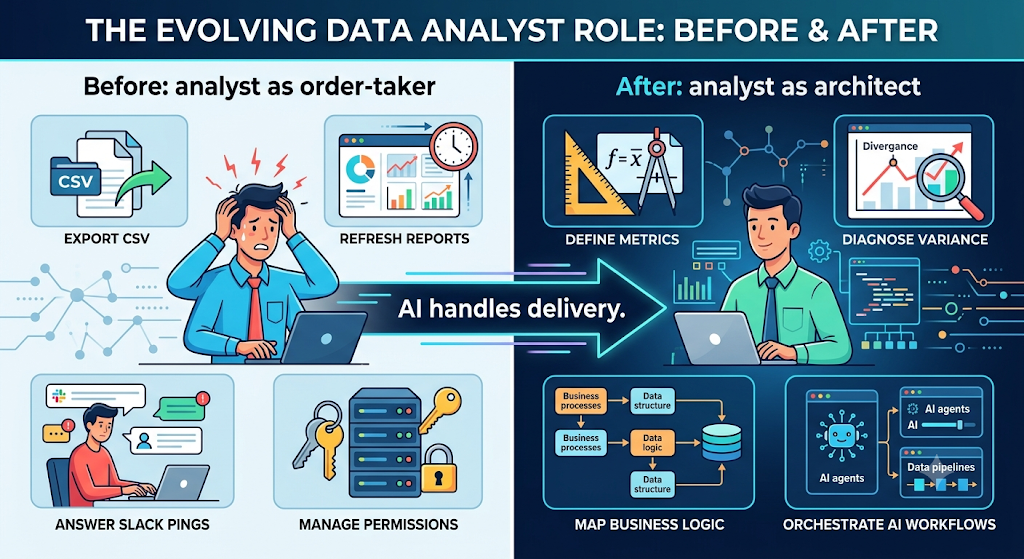
I’ve talked to dozens of analytics leaders about this, and the fear is always the same: “If you automate the reporting, what’s left for my people to do?” The answer: everything that actually matters.
Here’s what stays human – and grows in value when the delivery work is automated:
Data integrity and quality assurance. An AI can run a query. It can’t decide whether the underlying data is trustworthy, whether a tracking implementation is producing clean events, or whether a source schema change broke the pipeline.
Business-logic mapping. Translating “we need churn data” into the right query requires understanding what churn means in your specific business context. That’s judgment, not automation.
Metric definitions and governance. Deciding that “active user” means “logged in within 7 days, excluding internal accounts” – and enforcing that definition across every report – is an analyst’s job.
Variance diagnosis. The numbers dropped 15% last Tuesday. An AI can flag the anomaly. A human analyst figures out that it was a tracking tag that fired twice on mobile after the app update.
Stakeholder translation. Converting data into decisions requires knowing the business, the audience, and the politics. This is where analysts earn their strategic seat.
Orchestrating AI workflows. Deciding which data marts to build, which joins to configure, which access controls to set – analysts become the architects of the AI analytics system.
The punchline: analysts move from order-takers to architects and governors. The reporting backlog disappears – not because the questions stop, but because the answers are automated. The analyst’s time shifts from delivery to design.
That’s a promotion, not a replacement.
Why you can trust the numbers
Why you can trust the numbers
AI analytics only works if the output is trustworthy. Here’s how OWOX guarantees it.
No hallucinations – by design
OWOX’s architecture separates computation from narration. Every number is the result of deterministic, analyst-approved SQL – executed against your actual warehouse data, fully traceable, fully auditable. The AI’s role is to draft narrative prose around those numbers – summarize trends, highlight anomalies, translate metrics into language business users understand. But the AI never computes a metric, never infers a join, never guesses at a column definition.
This is the fundamental difference between OWOX and general-purpose AI analytics tools. When an AI narrates what SQL already proved, hallucination isn’t a risk – it’s architecturally impossible for the numbers.
No semantic layer required
The traditional path to governed self-service runs through a semantic layer – a universal metric-definition layer that business users query through a BI tool. It’s the right idea with the wrong timeline. OWOX replaces it with reusable data marts: analyst defines the query, the output schema, and the access controls once. Everyone else pulls from the mart – in Google Sheets, Looker Studio, Slack, or email. No 6-month modeling project. No BI training.
Your data never leaves your warehouse
OWOX connects to BigQuery, Snowflake, Databricks, Redshift, and Athena. Your data stays where it lives. The open-source core means no vendor lock-in – you can inspect every line of code that touches your data. For data leaders facing board-level scrutiny on data governance, this matters: 53.7% of CDOs serve less than three years (MIT Sloan, 2025), and Gartner warns that 75% of CDAOs who fail to demonstrate AI’s positive impact will be reassigned or removed by 2027. You can’t afford a governance gap.
The economics of hiring an AI analyst
The economics of hiring an AI analyst
We analyzed 1,438 job postings for reporting data analysts at US ecommerce SMBs. Here are the skills those roles require – and how OWOX automates each one.
| Skill on the job posting | ~% of listings | How OWOX handles it |
|---|---|---|
| Writing & maintaining SQL | ~95% | Reusable, version-controlled Data Marts |
| Integrating data from sources | ~85% | Open-source connectors, zero data engineering |
| Building & maintaining reports | ~80% | One Mart → Sheets, Looker Studio, Slack, email |
| Scheduling & timely delivery | ~70% | Built-in scheduler – set once, runs forever |
| Enabling stakeholder self-service | ~65% | Mart library in Google Sheets – no tickets |
| Managing access & permissions | ~40% | Owners + context-based access per Mart |
The math is straightforward. Companies pay $70,000–$120,000 per year for these skills packaged as a human role. OWOX starts at $0 (the Data Intern is free) and scales to $90/mo for governed AI insights with the Senior Analyst.
The Enterprise tier handles company-wide deployment at custom pricing.
This isn’t about whether you need human analysts – you do. It’s about whether those analysts should spend their time on the six skills in the table above, or on the work that only humans can do: defining the right metrics, diagnosing why the numbers moved, and translating data into business decisions.
The hand-off is the product
The hand-off is the product
The goal was never to build another dashboard tool. The goal is to make the hand-off between analyst and business user seamless and governed.
Analysts define the logic once – the SQL, the output schema, the access controls, the refresh schedule. Business users self-serve trusted answers in the tools they already use: Google Sheets, Slack, email. The reporting backlog disappears. The analyst’s role gets more interesting, not less relevant. And every number traces back to a query that a human approved.
That’s the open-source AI analytics team you hire.
Three ways to start:
1. Start free – hire your first Data Intern, no credit card required
2. Compare the team – see which analyst fits your use case
3. View the open-source core on GitHub – inspect every line of code
FAQ
What is the ROI of automating reporting vs hiring another analyst?
Companies pay $70,000–$120,000 per year for the reporting skills that OWOX automates: writing SQL, integrating data, building reports, scheduling deliveries, enabling self-service, and managing access. OWOX starts free with the Data Intern tier and scales to $90/mo for the Senior Analyst with governed AI insights. The ROI isn't just cost savings — it's freeing your existing analysts to do strategic work instead of processing ad-hoc requests.
How is an AI analytics team different from Tableau or Power BI?
BI tools like Tableau and Power BI require business users to learn a new interface, build their own visualizations, and understand data models. An AI analytics team flips the model: analysts define the logic once in reusable data marts, and business users consume trusted answers in tools they already use — primarily Google Sheets and Slack. No BI training required, no dashboard adoption problem, and every number traces back to analyst-approved SQL.
Does AI analytics work with my existing data warehouse?
Yes. OWOX connects to BigQuery, Snowflake, Databricks, Redshift, and Athena. Your data never leaves your warehouse — OWOX queries it in place and delivers results to Google Sheets, Looker Studio, Slack, or email. The open-source core means you can inspect every line of code that touches your data, and there's no vendor lock-in.
How long does it take to set up an AI analytics team?
The Data Intern tier is free and can be set up in minutes — connect your data warehouse, create your first data mart, and start delivering data to Google Sheets. The Reporting Analyst and Senior Analyst tiers add governed self-service, anomaly detection, and natural language access via Slack and ChatGPT. Most teams are running automated reports within their first day.
Can you trust AI analytics to be accurate?
It depends on the architecture. General-purpose AI tools (ChatGPT, Gemini) hallucinate 58–82% of the time when applied to raw data, according to Stanford HAI research. OWOX solves this by separating computation from narration: every number comes from deterministic, analyst-approved SQL executed against your warehouse. The AI only drafts narrative prose around those numbers — it never computes a metric or infers a join. This makes hallucination architecturally impossible for the numbers themselves.
Are data analysts going to be replaced by AI?
No. AI automates the delivery work — pulling data, building reports, scheduling refreshes — but the strategic work stays human. Data integrity, business-logic mapping, metric governance, variance diagnosis, and stakeholder translation all require human judgment. When delivery is automated, analysts move from order-takers to architects and governors of the analytics system. Their role becomes more valuable, not less relevant.
What does an AI data analyst actually do?
An AI data analyst automates the repetitive skills of a human reporting analyst — writing SQL, integrating data from sources, building and scheduling reports, and enabling stakeholder self-service. Unlike general-purpose AI chatbots, a governed AI analyst like OWOX delivers numbers from deterministic, analyst-approved SQL rather than generating answers from raw data. The human analyst stays in control of metric definitions, data quality, and business logic.
Topics
About the author

Related articlesSee all articles →