
Crow’s Foot Notation
What Is Crow’s Foot Notation in ER Diagrams?
Crow’s Foot Notation is a visual language used in Entity-Relationship (ER) diagrams to represent how data entities relate to one another.
Crow’s Foot Notation uses a set of symbols, lines, dots, and “crow’s foot” marks to clearly show relationships and cardinality between entities, such as one-to-many or many-to-many. This notation is widely used in database design to help analysts, developers, and stakeholders understand how different parts of a system connect. Its visual clarity makes it easier to model systems before implementation.
Origins and Evolution of Crow’s Foot Notation
Origins and Evolution of Crow’s Foot Notation
Crow’s Foot Notation originated from a paper by Professor Gordon Everest, who used an “inverted arrow” to illustrate relationships in entity diagrams. This intuitive style was later nicknamed “chicken feet” before becoming widely known as “crow’s foot.”
It gained popularity for visually representing many-to-one relationships without implying direction. The style was standardized at International Computers Limited (ICL) and may have influenced the development of Barker’s notation, which was later adopted by Oracle. Today, the crow’s foot remains a common standard in ER modeling.
Benefits of Using Crow’s Foot Notation in Data Modeling
Benefits of Using Crow’s Foot Notation in Data Modeling
Crow’s Foot Notation offers clear advantages for database design and team collaboration.
Here are its key benefits:
- Clear Visual Representation: Symbols like the three-pronged crow’s foot make it easy to understand relationships and cardinality at a glance.
- Better Communication: Its simplicity helps technical and non-technical team members align quickly, reducing confusion.
- Accurate Representation: Supports one-to-one, one-to-many, and many-to-many relationships with precision.
- Industry Standard for ERDs: Widely accepted in software engineering, business modeling, and academia, making it a trusted notation.
Core Symbols and Cardinalities in Crow’s Foot Notation
Core Symbols and Cardinalities in Crow’s Foot Notation
Crow’s Foot Notation uses a set of standard symbols to represent entities, relationships, and cardinalities clearly in ER diagrams:
-
Entities and Attributes
- Entities (Rectangles): Represent sets of similar objects, like “Customer” or “Order”.
- Attributes (Ovals): Connected to entities, showing data elements like “Name” or “Order Date”.
-
Relationships
- Binary: Links between two distinct entities.
- Recursive: An entity related to itself, like “Employee manages Employee”.
-
Cardinality and Modality
- 1:1: One entity matches exactly one in another set.
- 1:M: One entity links to many others.
- M:N: Many entities connect to many others.
- Optional vs. Mandatory: Participation in a relationship can be required or not.
Practical Use Cases for Crow’s Foot Notation
Practical Use Cases for Crow’s Foot Notation
Crow’s Foot Notation is widely used in both professional and academic settings for its clarity and consistency in modeling relationships.
Key use cases include:
- Database Design: Helps structure relational schemas by clearly representing entities and their relationships.
- Business Process Modeling: Maps out workflows and data flow between departments or systems.
- System Architecture Planning: Visualizes data dependencies in software or system design.
- Educational Use: Teaches students how to model databases effectively using a clear visual syntax.
- Data Documentation: Creates consistent, readable documentation for ongoing system maintenance.
Best Practices for Modeling with Crow’s Foot Notation
Best Practices for Modeling with Crow’s Foot Notation
Using Crow’s Foot Notation effectively requires more than just knowing the symbols; it’s about applying them with clarity and purpose.
Follow these best practices to ensure your ER diagrams are consistent, readable, and aligned with business logic:
- Use Singular Entity Names: Represent entities as singular nouns (e.g., Order, Invoice) for clarity.
- Ensure Symbol Consistency: Stick to standard symbols—dash for ‘one’, crow’s foot for ‘many’, circle for optional.
- Validate Cardinality Early: Align relationship rules with business logic before finalizing the model to ensure consistency.
- Label Relationships Clearly: Add verb phrases (e.g., manages, belongs to) to clarify the connection.
- Keep Layout Clean: Avoid clutter by spacing entities and minimizing line crossings to maintain a clean layout.
- Add Context Where Needed: Use notes or comments to explain complex relationships.
- Review and Update Regularly: Keep models aligned with system or business changes through periodic reviews.
Model Relationships Clearly with OWOX Data Marts
Model Relationships Clearly with OWOX Data Marts
Crow’s Foot Notation helps visualize entity relationships, but keeping those relationships consistent across reports can be difficult. With OWOX Data Marts, analysts can translate these visual models into governed, reusable data marts that preserve defined joins, cardinalities, and dependencies within your warehouse.
Build once, document clearly, and reuse confidently across Sheets, dashboards, and BI tools.
Topics
Related terms


Related articles
Customer stories
Learn how teams ship analytics faster
Organizations that scaled analytics without scaling headcount
 "For 10 years I was blind." The day Pürblack® founder stopped guessingSecondsto get reports across six channelsRead the story
 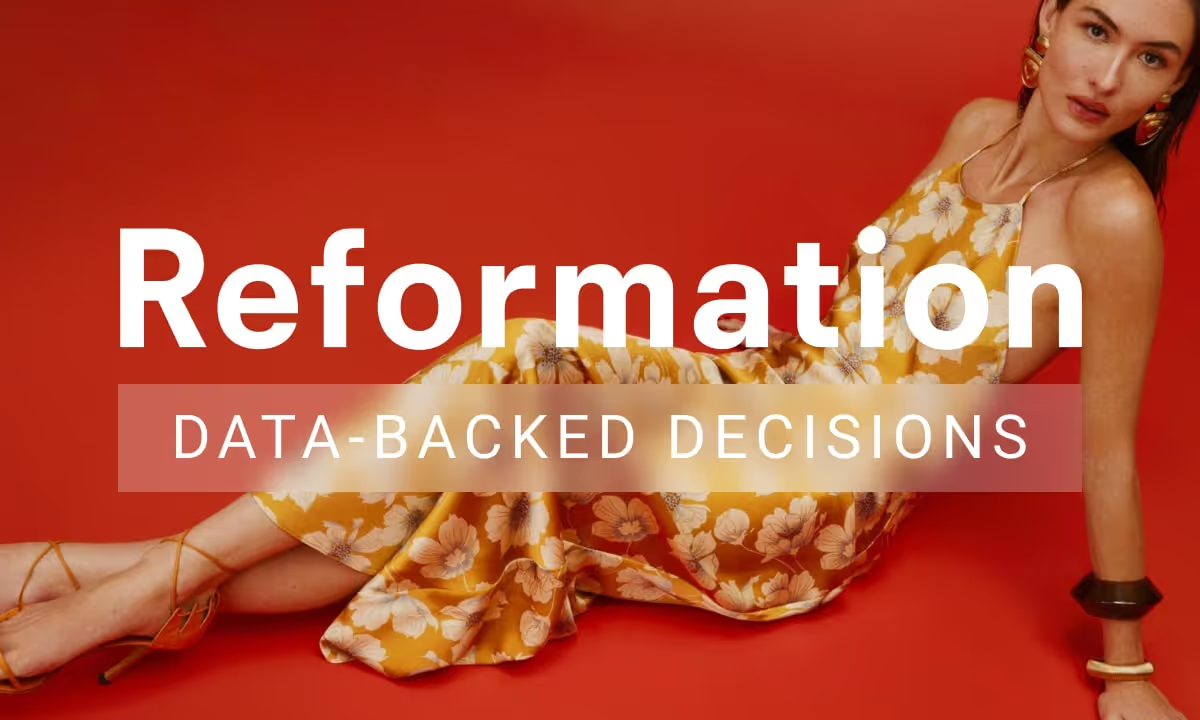 How OWOX Reports Helped Reformation Make Data-Backed DecisionsMinutesfrom data request to business decisionRead the story
  How OWOX Reports Streamlined Operations for WorkSimpli, Saving Over 10 Hours Weekly10hrs+saved per week on manual reportingRead the story
 What users are saying
Not testimonials. Comment threads.
Real things real customers said — each quote pinned to a specific claim, straight from the quotes database.
 Nodari RizunFounder & CEO, Pürblack®
“AI, by the nature of the models, will hallucinate. And because of that, you need something which will create guardrails to ensure that there are no hallucinations, that you can trust your data.”
Nodari RizunFounder & CEO, Pürblack®“I was blind, now I can see. OWOX opened our eyes.”
“We are extremely satisfied with the results achieved through our partnership with OWOX. I'm also impressed by quick and effective support we get from OWOX”