
Recursive Iteration Limit in SQL
What Is the Recursive Iteration Limit in SQL?
The Recursive Iteration Limit in SQL defines the maximum number of times a recursive Common Table Expression (CTE) can execute itself.
The Recursive Iteration Limit prevents infinite loops or excessive computation during recursive queries, ensuring the query terminates safely when the defined limit is reached. This safeguard is crucial when dealing with hierarchical data, such as organization charts, folder trees, or category relationships.
Key Characteristics of the Recursive Iteration Limit in SQL
Key Characteristics of the Recursive Iteration Limit in SQL
The recursive iteration limit controls how deeply a recursive query can run before stopping automatically. SQL engines use this mechanism to maintain stability and prevent overconsumption of resources.
- Default Limits: Most systems set the limit to 100 iterations by default (e.g., SQL Server, BigQuery).
- Adjustable Setting: Developers can modify the limit depending on query complexity.
- Error Handling: If the limit is exceeded, the system stops the query and throws an error.
- Performance Protection: Ensures queries don’t run indefinitely or overload the database.
- Safety Mechanism: Protects against poorly designed or infinite recursive logic.
- Consistency: Guarantees predictable behavior across recursive computations.
Benefits of Defining a Recursive Iteration Limit in SQL
Benefits of Defining a Recursive Iteration Limit in SQL
Setting a recursive iteration limit helps keep SQL queries efficient and secure.
- Prevents Infinite Loops: Ensures recursive queries always terminate.
- Improves System Stability: Reduces memory and CPU strain.
- Supports Controlled Recursion: Enables testing recursion depth safely.
- Optimizes Performance: Allows predictable execution time for recursive operations.
- Enhances Debugging: Helps identify logical errors early in recursive query design.
By managing iteration limits, analysts can maintain both query accuracy and system reliability across large datasets.
Limitations and Challenges of the Recursive Iteration Limit in SQL
Limitations and Challenges of the Recursive Iteration Limit in SQL
While beneficial, iteration limits can sometimes restrict flexibility in recursive queries.
- Fixed Limits: Some SQL engines restrict maximum recursion depth to prevent misuse.
- Incomplete Results: Legitimate queries may be cut off if the limit is too low.
- Manual Configuration: Requires fine-tuning for complex data hierarchies.
- Error Overhead: Exceeding the limit results in query failure and debugging time.
- Cross-Platform Variation: Different databases handle recursion limits differently, requiring environment-specific adjustments.
Balancing safety and completeness is essential when configuring recursion boundaries.
Best Practices for Managing the Recursive Iteration Limit in SQL
Best Practices for Managing the Recursive Iteration Limit in SQL
To handle recursion efficiently, apply these practices when working with recursive queries:
- Set a Reasonable Limit: Adjust based on dataset size and hierarchy depth.
- Include Stop Conditions: Define clear termination logic using WHERE clauses.
- Test Incrementally: Validate smaller recursion depths before scaling up.
- Monitor Performance: Check query execution time and resource usage.
- Use System Defaults Wisely: Default limits are often safe for most queries.
- Document Limits: Keep track of recursion parameters for reproducibility.
Following these steps ensures recursion stays efficient and aligned with business data modeling needs.
Real-World Applications of the Recursive Iteration Limit in SQL
Real-World Applications of the Recursive Iteration Limit in SQL
The recursive iteration limit is applied in queries that handle hierarchical or self-referencing data.
- Organizational Charts: Retrieve employees reporting under each manager within a safe recursion depth.
- Product Categories: Build relationships among parent and subcategory levels.
- Web Crawling: Control recursion depth while traversing linked pages.
- Financial Rollups: Aggregate multi-level account structures efficiently.
- Data Lineage: Track dependencies in transformation pipelines.
These applications highlight how iteration limits protect performance while supporting complex business analytics.
Stay Within Limits with OWOX Data Marts
Stay Within Limits with OWOX Data Marts
OWOX Data Marts Cloud helps analysts manage complex recursive queries and CTEs with confidence. Define recursion safely, automate query refreshes, and maintain consistency across Sheets, Looker Studio, or dashboards. With centralized metric governance, scalable data processing, and clear logic visibility, OWOX ensures your SQL workflows stay efficient, stable, and error-free.
Topics
Related terms
Related articles


Customer stories
Learn how teams ship analytics faster
Organizations that scaled analytics without scaling headcount
 "For 10 years I was blind." The day Pürblack® founder stopped guessingSecondsto get reports across six channelsRead the story
 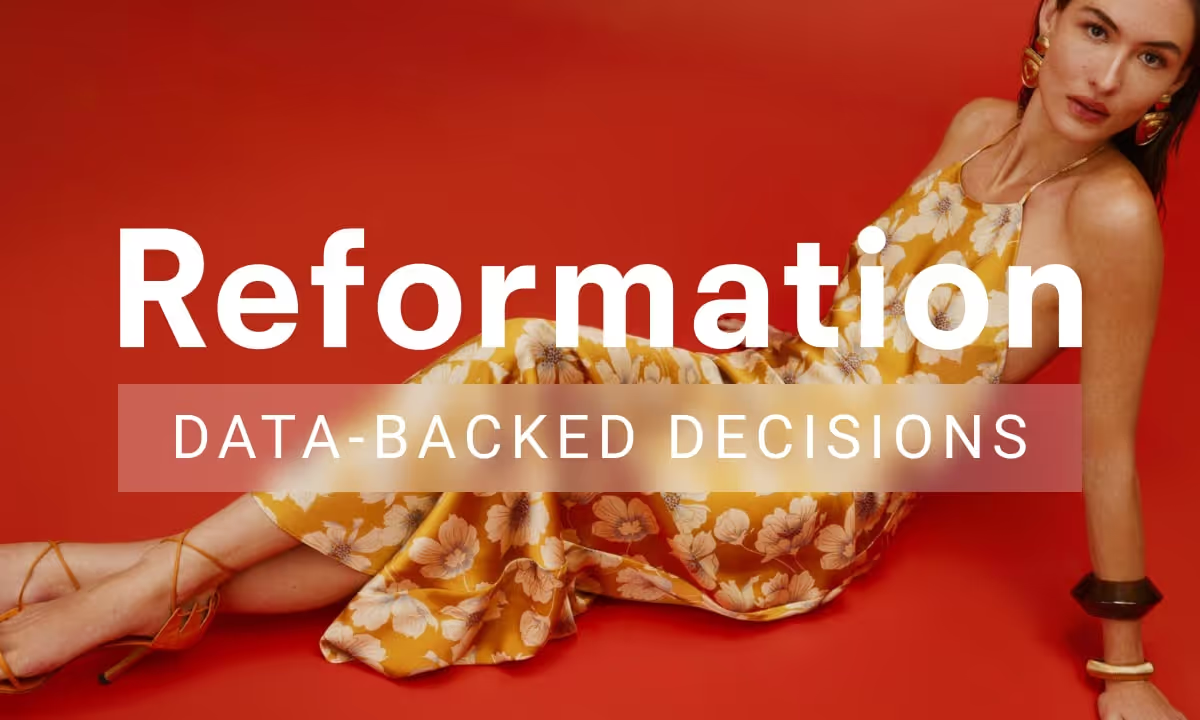 How OWOX Reports Helped Reformation Make Data-Backed DecisionsMinutesfrom data request to business decisionRead the story
  How OWOX Reports Streamlined Operations for WorkSimpli, Saving Over 10 Hours Weekly10hrs+saved per week on manual reportingRead the story
 What users are saying
Not testimonials. Comment threads.
Real things real customers said — each quote pinned to a specific claim, straight from the quotes database.
 Nodari RizunFounder & CEO, Pürblack®
“AI, by the nature of the models, will hallucinate. And because of that, you need something which will create guardrails to ensure that there are no hallucinations, that you can trust your data.”
Nodari RizunFounder & CEO, Pürblack®“I was blind, now I can see. OWOX opened our eyes.”
“We are extremely satisfied with the results achieved through our partnership with OWOX. I'm also impressed by quick and effective support we get from OWOX”