Data Integration
Why Open-Source Analytics Is the Future for Analysts
TL;DR: Analysts are done firefighting CSVs and black-box tools. The future is a transparent, composable analytics stack you can inspect, extend, and trust – powered by open source.
The Analyst’s Reality – and Why It Must Change
The Analyst’s Reality – and Why It Must Change
Most analysts still juggle manual exports, fragile spreadsheets, and vendor limits while fielding a flood of “quick questions.” Meanwhile, two-thirds of enterprise data often goes unused, so decisions are made with partial context and old numbers. The core issue isn’t tooling – it’s control. Open source gives analysts that control back.
What “Open-Source Analytics” Really Means
What “Open-Source Analytics” Really Means
Open-source analytics isn’t one tool – it’s a composable stack:
- Data collection: A lightweight, expandable, community-driven connector catalog you can extend yourself (e.g., JS Connectors) or a heavyweight, but powerful Airbyte.
- Reusable Reporting Library - Data Marts
- Transformation: dbt brings versioned SQL, tests, and docs to analytics teams, but mostly for data engineering.
- Open table formats: Apache Iceberg lets multiple engines safely read and write the same tables – and major platforms support it.
- Data governance: OpenLineage standardizes lineage, so audits are reproducible.
- Visualization: Apache Superset provides modern, open dashboards that can replace or augment proprietary BI.
Bottom line: open components plug together into a data stack you can evolve without begging a vendor for features or paying for a cloud SaaS tool.
Where OWOX Fits in This Stack
Where OWOX Fits in This Stack
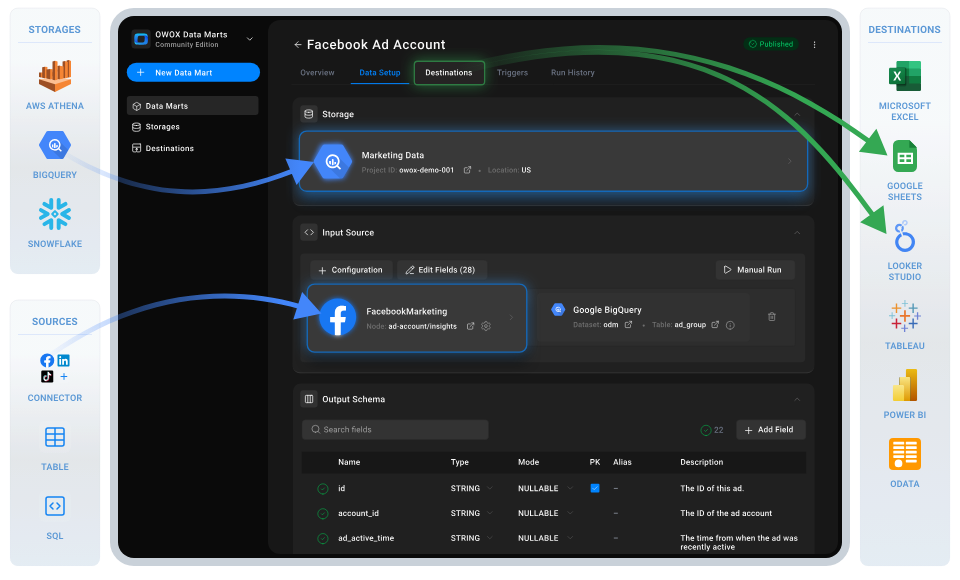
OWOX Data Marts is a practical on-ramp to this future. It gives data teams, especially analysts, an open-source data connectivity layer and a reusable data marts layer with governed logic – so you can hand off trusted reports to business users without losing control anytime in the future.
You can self-host it, inspect, and extend everything if you want. You can start with the Google Sheets edition or go straight to the full self-hosted version.
Quick view:
- Google Sheets Connectors for popular advertising platforms, CRM, Accounting & databases built in Apps Script that run inside your sheets.
- The same connectors, but into popular data warehouses such as AWS Athena, BigQuery or Snowflake.
- Reusable reporting library with a semantic layer for clean, consistent metrics.
- Flexible delivery to spreadsheets or BI tools.
Why the Shift Is Inevitable – and Accelerating
Why the Shift Is Inevitable – and Accelerating
1. Control & transparency > black boxes
Open code architecture is auditable – you can see field lists, business logic, and data paths. Independent surveys consistently rank avoiding vendor lock-in and cost reduction among the top reasons for choosing open source tools.
2. Lower total cost of ownership
Having zero license costs of the SaaS itself and overall spend on maintenance is a leading driver for OSS adoption.
3. Interoperability is becoming the default
By connecting open-source tools to popular data warehouses, OSS tools end brittle and bespoke silos.
4. Built for the AI era
Organizations increasingly expect to grow their use of AI tools; most open source tools, like the Data Marts, allow you to keep schemas, lineage, and metrics transparent – the foundation for reliable AI.
OSS Concepts → Analyst Value → How OWOX Embodies It
OSS Concepts → Analyst Value → How OWOX Embodies It
| OSS concept | Why it matters to analysts | How OWOX embodies it |
|---|---|---|
| Open source connectors | Pull exactly the fields you need, avoid per-connector limits, and keep credentials safe - inside your environment. | With both: Google Sheets & Community Editions, you can inspect, tweak, and schedule data delivery to popular data warehouses. |
| Semantic layer & governed metrics | One definition of KPIs across every dashboard and report – fewer arguments, faster decisions. | Data Marts with documented metrics for consistent numbers across tools. |
| Reusable data marts | Stop rebuilding dashboards; model once, reuse everywhere. | You can reuse the same data marts across all BI tools: from Sheets to Looker Studio or Tableau. |
What This Means for Analysts
What This Means for Analysts

From reporting firefighters to product owners of data.
With an OWOX Data Marts, analysts own the whole logic layer – modeling, metrics, and lineage – and hand off trustworthy marts to business users. The role shifts from “ticket taker” to architect of a scalable analytics system.
A Pragmatic Open-Source Blueprint You Can Start Tomorrow
A Pragmatic Open-Source Blueprint You Can Start Tomorrow
- Pull data in – Use open source connectors or an alternative by Airbyte.
- Model & transform – Standardize business logic inside your data warehouse or with dbt Core.
- Query where it lives – Use DuckDB for ad-hoc work, and Trino for cross-source analytics.
- Visualize – Start with Google Sheets or Apache Superset.
Prefer the easy on-ramp? Start with OWOX Data Marts to get open source data connectivity, a semantic layer, and a reusable data marts library in one tool designed specifically for giving more control to data analysts responsible for reporting and keeping it all together.
Common Objections – Quick, Practical Answers
Common Objections – Quick, Practical Answers
“Security & compliance.”
With self-hosted OSS and open standards, you keep credentials, data paths, and change logs inside your environment, aligning with least-privilege and auditability. Independent research also highlights open source as a way to reduce lock-in and improve transparency.
“Who supports this?”
Mature OSS stacks have thriving communities. You’re not tied to a single roadmap by a vendor – you can switch vendors or contribute fixes instead of waiting on tickets.
“Isn’t this more work?”
Initial setup is an investment, but it eliminates recurring friction – connector field gaps, opaque transformations, and untraceable dashboard logic. The ongoing velocity gain is the point.
What’s Next?
What’s Next?
- Visit the OWOX GitHub to explore the open-source connectors and star the repo.
- Share this piece with a colleague who still exports CSVs every Monday.
{ “@context”: “https://schema.org”, “@type”: “Blog”, “name”: “Why Open‑Source Analytics Is the Future for Analysts”, “url”: “https://www.owox.com/blog/articles/future-of-open-source-analytics”, “about”: [ { “@type”: “Thing”, “name”: “Open-source software”, “sameAs”: “https://en.wikipedia.org/wiki/Open-source\_software” }, { “@type”: “Thing”, “name”: “Data analytics”, “sameAs”: “https://en.wikipedia.org/wiki/Data\_analysis” } ], “mentions”: [ { “@type”: “Thing”, “name”: “Data warehouse”, “sameAs”: “https://en.wikipedia.org/wiki/Data\_warehouse” }, { “@type”: “Thing”, “name”: “Business intelligence”, “sameAs”: “https://en.wikipedia.org/wiki/Business\_intelligence” }, { “@type”: “Thing”, “name”: “Semantic layer”, “sameAs”: “https://en.wikipedia.org/wiki/Semantic\_layer” } ] }
{ “@context”: “https://schema.org”, “@type”: “FAQPage”, “mainEntity”: [ { “@type”: “Question”, “name”: “What is open-source analytics?”, “acceptedAnswer”: { “@type”: “Answer”, “text”: “Open-source analytics is a composable stack of tools and formats you can inspect, extend, and self‑host. It prioritizes transparency, interoperability, and no vendor lock‑in.” } }, { “@type”: “Question”, “name”: “How is open-source analytics different from proprietary BI?”, “acceptedAnswer”: { “@type”: “Answer”, “text”: “Proprietary stacks hide logic and limit flexibility. Open-source stacks let analysts control schemas, connectors, and metrics definitions – improving trust, auditability, and speed.” } }, { “@type”: “Question”, “name”: “Is open-source analytics secure for enterprises?”, “acceptedAnswer”: { “@type”: “Answer”, “text”: “Yes. Self‑hosting keeps credentials and data flows inside your environment, while open code enables audits and compliance reviews. Governance is implemented at the semantic and access layers.” } }, { “@type”: “Question”, “name”: “What skills do analysts need to adopt open-source analytics?”, “acceptedAnswer”: { “@type”: “Answer”, “text”: “Versioned SQL and testing, basic modeling concepts, and comfort with open table formats. Most teams start small – then grow into lineage, scheduling, and orchestration.” } }, { “@type”: “Question”, “name”: “How does OWOX Data Marts fit into an open-source stack?”, “acceptedAnswer”: { “@type”: “Answer”, “text”: “OWOX provides open connectors plus reusable data marts and a semantic layer, so analysts can define metrics once and enable governed self‑service in Sheets or BI tools without losing control.” } } ] }
FAQ
How does OWOX Data Marts fit into an open-source stack?
OWOX provides open connectors plus reusable data marts and a semantic layer, so analysts can define metrics once and enable governed self-service in Sheets or BI tools without losing control.
What skills do analysts need to adopt open-source analytics?
Versioned SQL and testing, basic modeling concepts, and comfort with open table formats. Most teams start small – then grow into lineage, scheduling, and orchestration.
Is open-source analytics secure for enterprises?
Yes. Self-hosting keeps credentials and data flows inside your environment, while open code enables audits and compliance reviews. Governance is implemented at the semantic and access layers.
How is open-source analytics different from proprietary BI?
Proprietary stacks hide logic and limit flexibility. Open-source stacks let analysts control schemas, connectors, and metrics definitions – improving trust, auditability, and speed.
What is open-source analytics?
Open-source analytics is a composable stack of tools and formats you can inspect, extend, and self-host. It prioritizes transparency, interoperability, and no vendor lock-in.
Topics
About the authors


Related articlesSee all articles →