Case StudiesDigital Agency
How to automate ad campaign reports for a digital agency
1.5 wksreporting time reclaimed per month

Among the main challenges for marketers is the necessity to constantly prove that marketing activities bring tangible revenue. However, with growing online competition and restrictions in collecting third-party data, it becomes increasingly difficult to adapt. Still, marketers have to provide answers to such questions as what efforts and decisions worked out. Without advanced automated reporting, it’s impossible to evaluate marketing efficiency, control ad cost spending, and improve marketing.
In this case, we describe the solution provided by the OWOX BI team for the digital agency that specializes in online marketing, web analytics, SEO, and mobile app promotion.
Task
Task
At the beginning of each month, PPC specialists from the digital agency prepare detailed reports for the clients on the previous month’s ad campaigns. As the agency grew and had more clients to work with, marketers needed more and more time to prepare these reports.
Eventually, a difficulty arose: most of the first one and a half weeks of each month PPC specialists were preparing reports on the previous month and barely had time to set up new campaigns for the clients.
Since the report overload wasn’t constant, extending the PPC department wasn’t a viable option. To avoid sacrificing the quality of the work, the decision was to optimize the whole reporting workflow.
Solution
Solution
For preparing ad campaign reports faster, Google Data Studio was chosen to create automatically updated reports.
Google Data Studio can transfer the data from Google Analytics and update reports automatically when data is updated in Google Analytics. This means that marketing specialists need to prepare a report only once; after that, they just need to keep it relevant and modify it if needed.
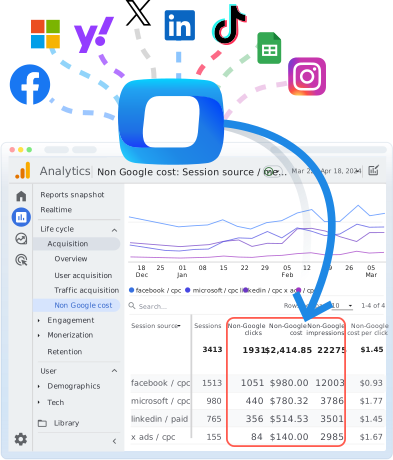
However, to get all the required data into Google Data Studio, all ad cost data must be first imported to Google Analytics (in the same currency and with all taxes considered). And as Google Analytics can’t automatically import ad cost data from non-Google ad platforms, the solution was to apply the OWOX BI service.
OWOX BI can automatically import cost data to Google Analytics from all popular ad platforms, converting costs into the currency set in Google Analytics. It also lets to manage whether to exclude taxes from imported ad costs. The ability to include taxes is very convenient when a client wants to see all their spendings. It’s always a difficult task as some ad services automatically exclude taxes from total ad costs.
Here’s how marketing specialists collect data for the clients’ reports:
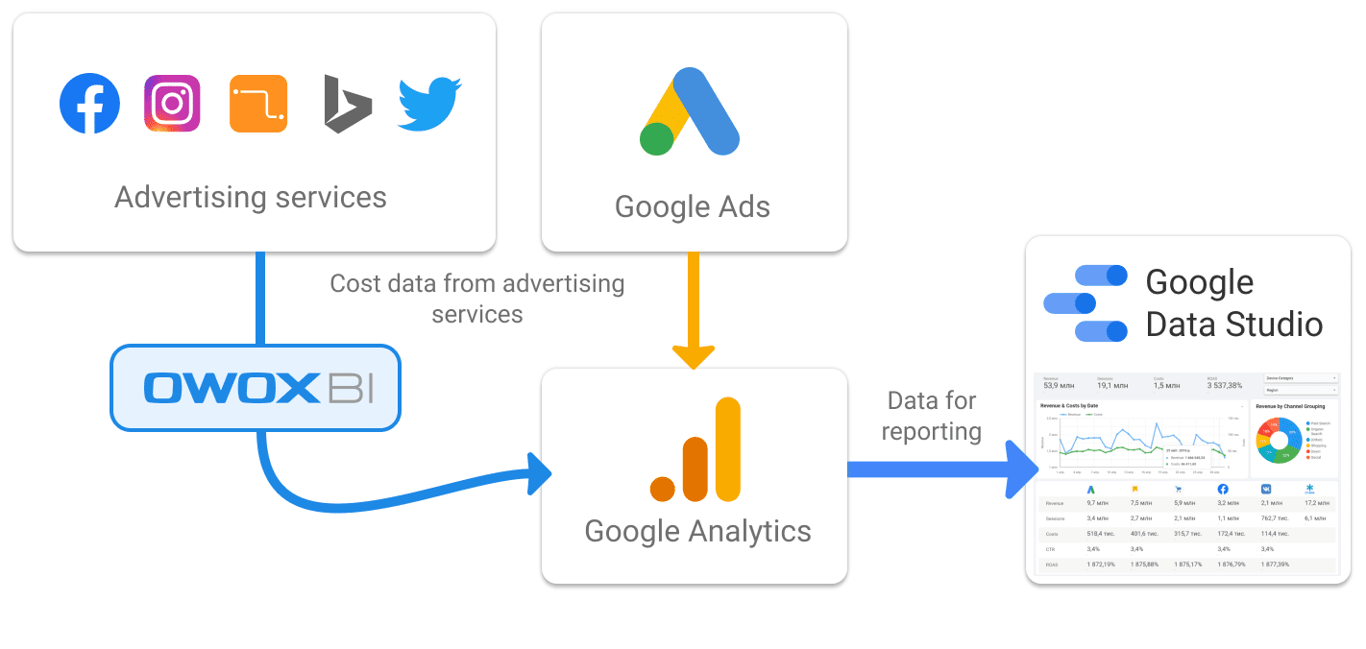
With OWOX BI Pipeline, data from ad services (plus ad cost data) were uploaded to Google Analytics. Ad campaign data from Google Ads and YouTube gets into Google Analytics via native integrations.
Once all the data comes in Google Analytics, it’s transferred to Google Data Studio and there the reports for clients are assembled. The reports are updated automatically as the source data is updated in Google Analytics.
Here’s an example of such a dashboard:
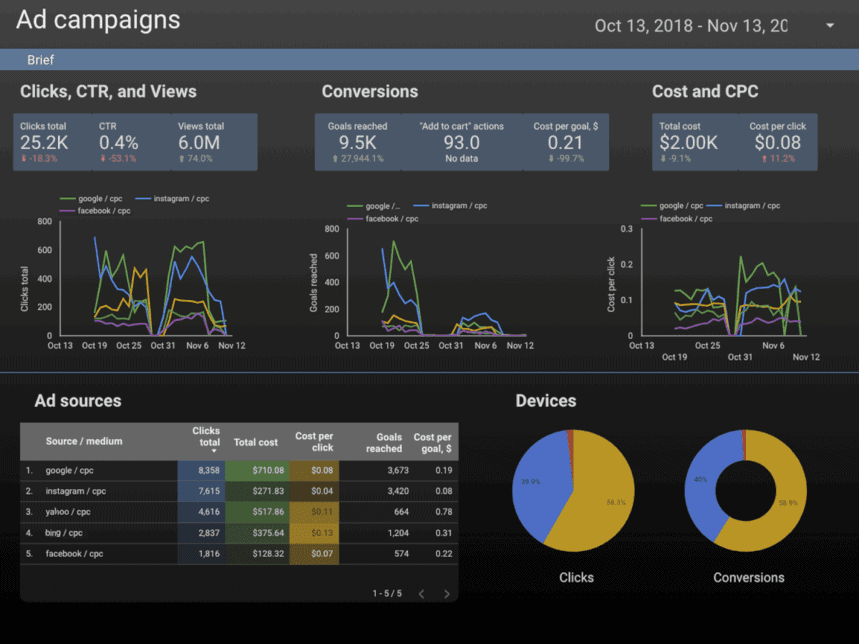
Using custom metrics in Google Data Studio, it’s possible to calculate the total conversion ratio and total cost of all advertising goals as well as the cost for each goal broken down by source, campaign, and targeting.
Thanks to Google Data Studio’s report visualization capabilities, the reports made for clients are useful for more than web analytics professionals. Anyone familiar with online advertising can analyze a report for any date range and draw useful conclusions from it.
Results
Results
OWOX BI’s ad cost export features coupled with Google Data Studio’s report visualization capabilities have allowed marketing specialists not only to optimize the ad campaign reporting workflow but to improve the quality of the reports.
Now, the clients of a digital agency can view statistics on all their ad sources and targets not just monthly, as they did before, but at any time and for any date range they choose.
So far, the digital agency has implemented the new reporting for half of its clients. This saves up to 90 hours of work by PPC specialists each month. Throughout the previous year, were saved 1080 hours in total, which is a full six months of one mid-level PPC specialist’s work. Now this time is spent on developing, pitching, and implementing new ad campaigns for clients.
The future plans of the digital agency are to use OWOX BI to gather data from Google Analytics, CRMs, and call tracking systems to Google BigQuery cloud storage, then use BigQuery as an extensive source for Google Data Studio reports. By applying such a solution, it’ll be possible to build advanced analytics solutions for the clients considering all customer touchpoints and confirmed transactions in the CRM as well as how online ads lead to offline purchases.
Topics
About the author

More stories